

The following blog post was written by Anne-Elise Cugliari Allegritti for Royal LePage – original blog here
June 23, 2026
Housing affordability has improved across many of Canada’s major cities in recent years, but for a growing number of urban residents, it may not be enough to stay put. For those living in the country’s largest and most expensive markets, relocating to a smaller city offers more than a lower mortgage payment – it represents a deliberate choice for a different way of life.
According to a recent Royal LePage® survey of Canadians living in the greater regions of Toronto, Montreal and Vancouver, conducted by Burson,1 half of respondents (51%) say they would consider buying a primary residence in one of Canada’s 15 most affordable cities, if they were able to find a job locally or work remotely.
The survey found Sherbrooke is the most popular relocation destination among residents of the Greater Montreal Area; 29% of respondents say they would consider purchasing a primary residence in Sherbrooke if they were able to find a job locally or work remotely. Meanwhile, Edmonton is once again the top-ranking choice among respondents in the Greater Toronto Area (16%) and Greater Vancouver (18%).
“Home prices in Canada’s largest cities have moderated over the past couple of years, but for many buyers, the math still doesn’t work,” said Phil Soper, president and CEO, Royal LePage. “As barriers to entry remain high in the country’s most expensive urban centres, relocating to a more affordable city is becoming less of a last resort and more of a deliberate strategy. Aspiring homeowners who cannot secure a foothold in these markets are seriously weighing their options, and renters – unburdened by existing roots – are more likely to make that move than established homeowners.”
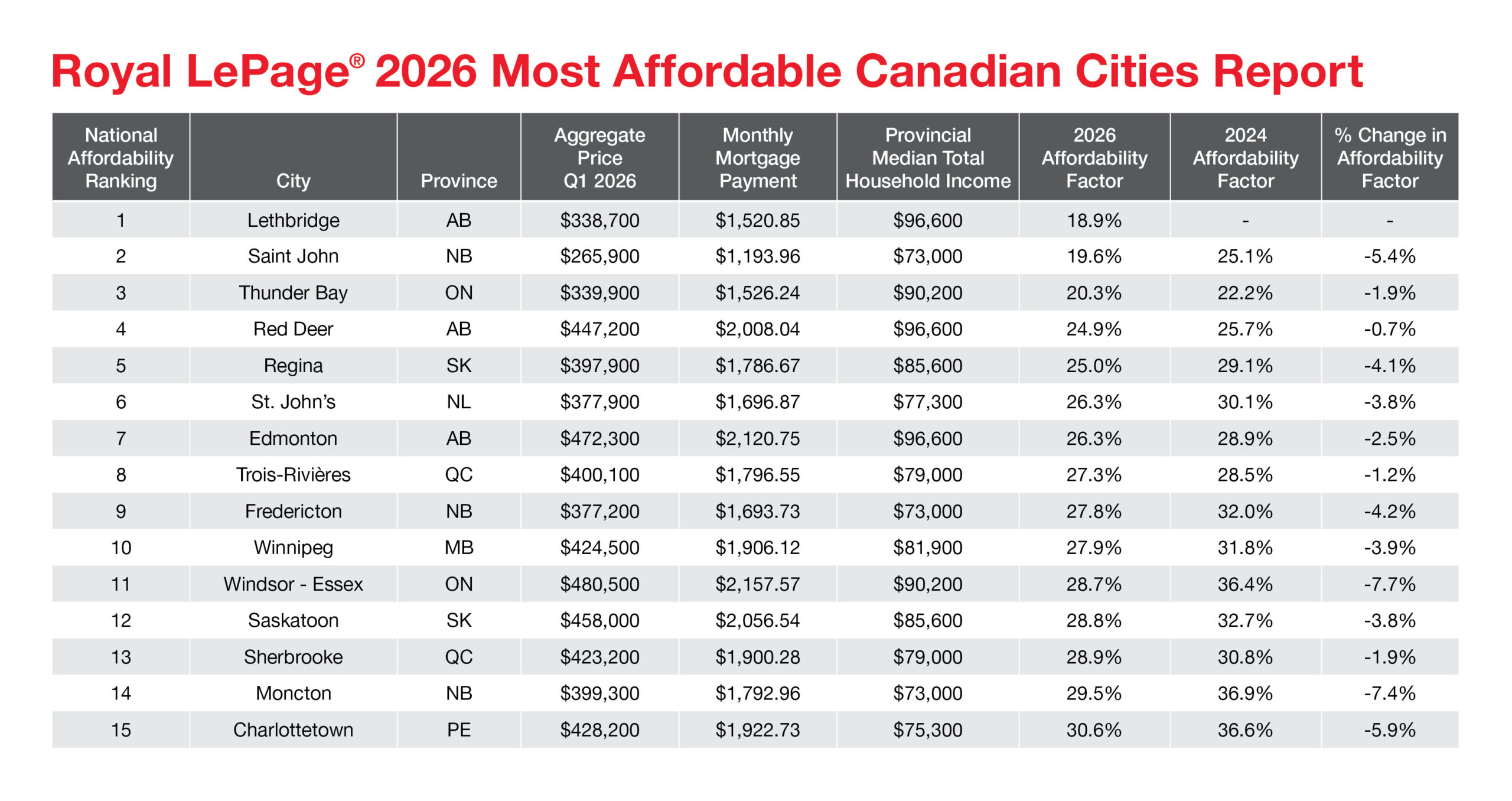
Lethbridge tops the list of most affordable cities in Canada, where 18.9% of a household’s monthly income would be required to service a mortgage payment. The Alberta city, followed by Saint John, takes over the top spot from Thunder Bay (currently ranked third), which ranked as the country’s most affordable market in 2024. Red Deer and Regina round out the top five, where no more than 25.0% of a household’s monthly income is needed to service a mortgage payment.
Most Canadian cities see affordability improve from 2024
Following a prolonged period of flat or softening home prices and reduced buyer activity, 61 of the 62 cities analyzed by Royal LePage between 2024 and 2026 recorded an improvement in the affordability factor, with gains concentrated in higher-priced markets. West Vancouver, Richmond, Markham, North Vancouver and Milton saw the largest decreases in the percentage of income required to service a monthly mortgage payment.
By comparison, cities that recorded the least improvement tend to already have some of the most affordable home prices in the country. In Red Deer, Trois-Rivières, Thunder Bay and Sherbrooke, the income required to service a monthly mortgage payment fell by less than 2.0%. Quebec City was the only market to register a deterioration in affordability, with the income required to service a mortgage rising by 1.6% since 2024.
“Over the past two years, home prices in Canada’s major urban centres – particularly Toronto, Vancouver and their surrounding communities – have softened, as demand in these higher-cost regions has been tempered by geopolitical and economic uncertainty, reduced immigration levels and an unprecedented increase in supply,” said Soper. “At the same time, cities where home prices are lower have seen more robust demand as buyers seek an entry point into the market, pushing prices up as a result.
“That said, local income relative to home prices remains a critical factor when assessing affordability, and the degree of improvement varies significantly from one market to the next. For residents already stretched by the higher cost of living, the gains from declining home prices may not yet be felt.”
Here are a few highlights from the Royal LePage 2026 Most Affordable Canadian Cities Report:
- 55% of respondents in the Greater Toronto Area, 48% in the Greater Montreal Area and 46% in Greater Vancouver would consider relocating to one of the 15 most affordable cities.
- Gen Z and Millennials are more likely to relocate in order to access more affordable housing compared to older generations.
- 55% of all respondents who say that they would consider relocating stated a lower cost of living as the main incentive to buy a property in one of the most affordable cities; 42% say they desire a more relaxed pace of life; and, 41% say they want to be closer to nature and live in a less populated area.
1Burson used the Leger Opinion online panel to survey 900 Canadian residents, aged 18+, living in Canada’s three largest urban areas: Greater Toronto, Greater Montréal, and Greater Vancouver. The survey was completed between June 2nd and June 4th, 2026. Equal sampling was done within each city, with age and gender quotas. Weighting was applied to reflect the relative sizes of the three cities, according to 2021 census figures.
2Royal LePage’s Affordability Factor is based on the percentage of income required to service a monthly mortgage payment, using Statistics Canada 2024 provincial median total income of economic families and persons not in an economic family, and city-level aggregate home price data from the Royal LePage Q1 2026 Home Price Update. The mortgage calculation is based on a three-year fixed-term loan at 4.64%, amortized over 25 years with a 20% down payment.